Loading print…
About this photograph
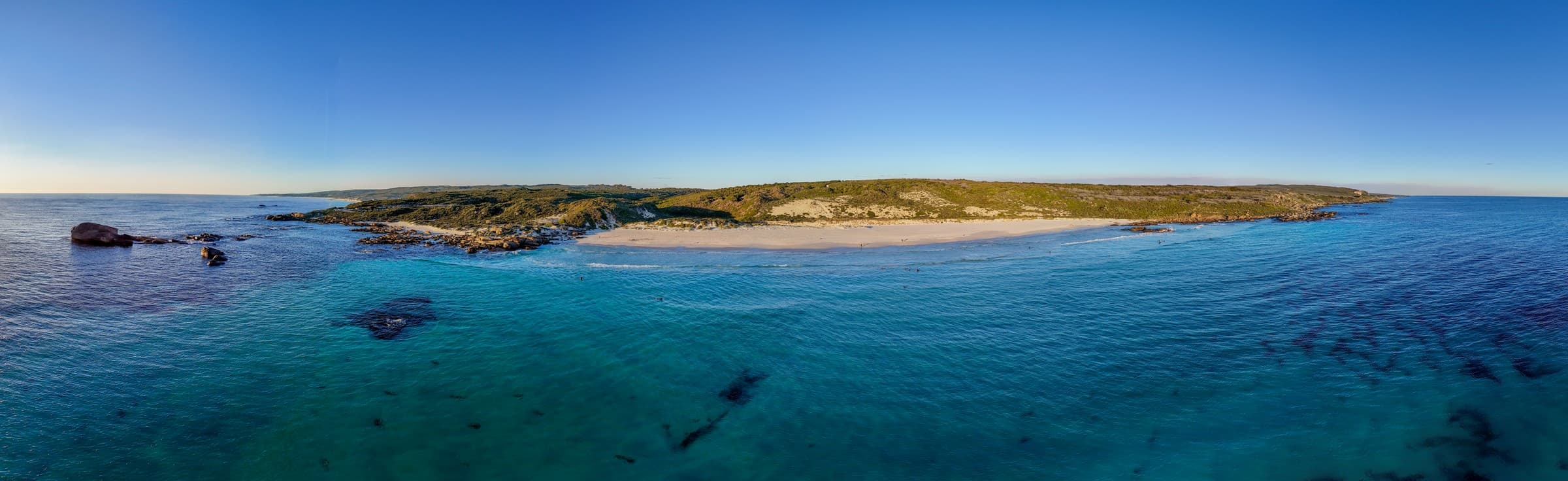
The wreck of the SS Georgette lies just offshore in this frame, hiding in plain sight. She has rested there for 150 years.
This is the photograph the whole exhibition turns on. It is a wide view of an unremarkable beach — sand, swell, headland, sky — and somewhere in the water in front of the camera is an iron steamship that has been on the bottom since 1 December 1876.
Nothing in the frame announces her. That is the point. The Georgette is not a monument or a marked site; she is a shape under moving water that most beach-goers pass without knowing. A hundred and fifty years of sand has covered and uncovered her, divers have taken her propellers and lost one of them again, and the sea has kept the rest.
Printed at panoramic width, the image asks the viewer to do what the photographer did for seven years before a drone finally showed him the hull: look at the water and take it on trust that the history is in there.
About Redgate Beach and Calgardup Bay
Redgate Beach sits on the Calgardup Bay shoreline south of Margaret River, on the section of coast now followed by the Cape to Cape Track. It is an ordinary-looking surf beach with an extraordinary thing underneath it: the wreck of the SS Georgette, which grounded here on the morning of 1 December 1876 after her pumps failed and rising water put out her boiler fires.
The wreck lies a few metres down, just offshore. On a rare day — low swell, clear water, low tide, the sand moved off her — the hull shows as a dark line from the beach or from the air. Most days it is invisible, and most people walking the sand have no idea it is there.
The full account of the wreck — the failed pumps, the lifeboat, Grace Bussell and Sam Isaacs, and the inquiry that followed — is set out in the story of the SS Georgette. The research behind it is described in the author's preface.
About the print
Printed to order on Hahnemühle Photo Rag, a 100% cotton archival paper, and supplied with an edition number. Free shipping within Australia.