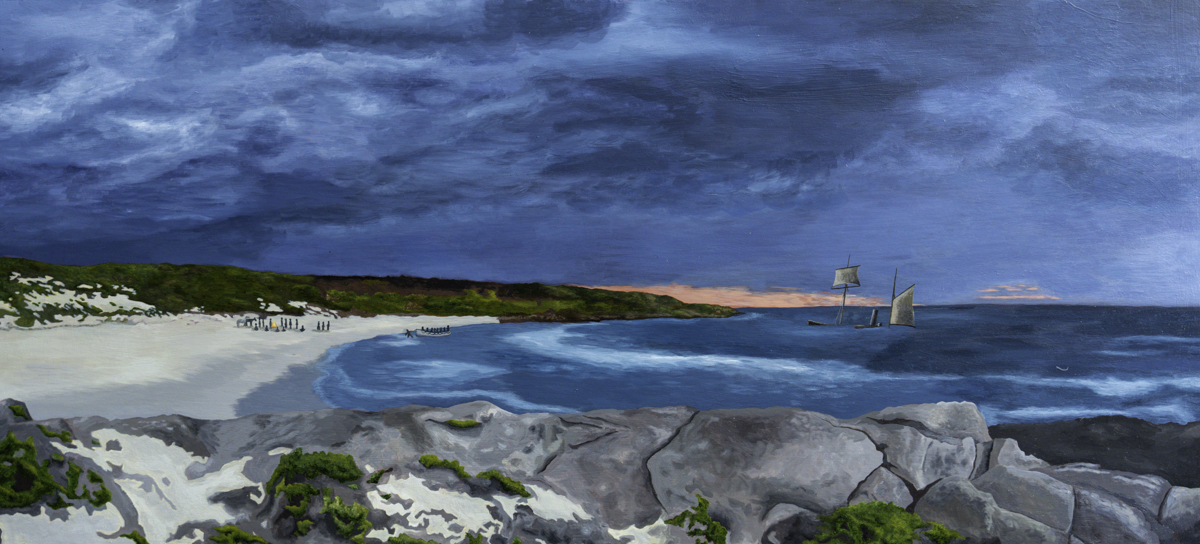
1 December 1876 · South-West Western Australia
The Story of the Georgette
A ship in trouble
The Georgette left Fremantle on 29 November 1876 — an iron screw-steamer under sail and steam, three years into colonial service, carrying fifty passengers and a cargo of jarrah south along the coast, bound for Adelaide. Eight months earlier the same ship had been fitted with a twelve-pounder gun and sent after an American whaleship carrying six escaped Fenian prisoners; she came back empty-handed, and the colonial government had been shopping for her replacement ever since. By the evening of 30 November, rounding Cape Naturaliste, the ship had begun to leak. The Chief Engineer reported extra water in the bilge. Captain John Godfrey was informed. He ordered the pumps checked and did not go below himself.
Shortly after midnight, midway between Cape Naturaliste and Cape Hamelin, the pumps failed outright. By 4am on 1 December, passengers and crew were bailing by bucket, and losing. Near dawn, the rising water reached the boilers and put out the fires. Godfrey turned the ship for shore. He had no other choice. With a flooding hull and dead engines, the beach was the only option that offered any chance of survival.
The lifeboat
In the darkness before dawn, with the ship going down fast, Godfrey ordered the lifeboat and gig launched. The women and children were placed aboard the lifeboat, some with infants in arms, under the charge of the first mate. The lifeboat was to be towed astern until the ship grounded and a safer landing could be arranged.
The gig, a smaller boat with 14 aboard, came to shore at Injidup beach miles to the north but the lifeboat never reached the shore. Ordered to slack the painter and let her drift clear, the mate did not; the next sea lifted her under the ship's counter, stove her in against the iron plating and capsized her. Seven people drowned — two women and five children. In the chaos that followed — crew jumping overboard, survivors clinging to the upturned hull — what had been a managed evacuation became a catastrophe.
The beach
The Georgette grounded in Calgardup Bay in the mid-afternoon of 1 December 1876. Approximately fifty passengers and crew made it ashore through the surf — some by the ship's remaining boats, some by a rope hauled between the ship and the beach, some by swimming.
While that was going on, Grace Bussell — sixteen years old, from the nearby Wallcliffe homestead — and Sam Isaacs, an Aboriginal stockman employed by her family, rode down through the dunes to the beach. What happened next has been told many ways.
The press at the time credited Grace Bussell with riding repeatedly into the surf to pull survivors to safety — a story that spread through the colony and reached London. She was compared to Grace Darling, the English lighthouse keeper's daughter celebrated for her own sea rescue. Medals were struck. Paintings were made. The legend was set — and its construction can be traced year by year through the newspapers, from the first comparison in 1877 to the survivor who, fifty-nine years later, remembered a revolver that was never there.
But passenger George Leake — a young law student who had been on board and narrowly escaped drowning — left his own, quieter account, contradicting parts of the published story. By his telling, the horses could not have kept their footing in surf that heavy; much of the landing had already been managed by the crew using a rope system before the riders arrived. He was at pains to say Grace Bussell had behaved admirably and would have gone further into the water had it been necessary. But his account of what she actually did was a far quieter thing than the legend required.
“The vessel was seen going ashore by one of Mr Bussell's stockmen, and he and one of the Miss Bussells came down to us on the beach; it was a great relief to see them, for then we knew help was near.” — George Leake, 1877
The man who was forgotten
Sam Isaacs saw the wreck first. He rode to the Bussell homestead to raise the alarm, and it was Grace who insisted on riding back to the beach with him — not the other way around. By one family account, passed down through Isaacs' own descendants, it was Isaacs who went into the surf again and again, hauling survivors clear, while Grace — after her horse struggled to hold its footing and Isaacs warned she risked drowning the very people she was trying to save — returned to the beach and stayed there.
For his part in the rescue, Isaacs was awarded the Royal Humane Society's bronze medal. Grace Bussell received the silver medal, a gold watch and chain paid for by public subscription, a place in the history books, and a town named after her. The land is often folded into Isaacs' story as though it were part of the same reward — it wasn't. He bought his hundred acres at Wallcliffe himself, in 1897, twenty-one years after the rescue, at full price, becoming the first Aboriginal person in Western Australia to hold a freehold Crown grant. That was his own doing, not a gift. Isaacs received a smaller medal, no land, no watch, and, in most tellings since, a supporting role in someone else's story.
Marcia van Zeller, whose research into the Georgette formed the basis of her doctoral novel The Capes, has argued that Sam Isaacs' contribution was systematically underplayed — not by any single act of erasure, but by the accumulated weight of a culture that found Grace Bussell's story more convenient, more romantic, and more publishable. How that legend was assembled, decade by decade, is set out in How the Grace Bussell legend was made. Van Zeller will give a public talk during the exhibition.
One hundred and fifty years
The Georgette's wreck lies a few metres beneath the surface of Calgardup Bay, just off Redgate Beach. On a calm day you can see the shadow of it from the shore. Most days you cannot.
John Bowskill has spent the past eight years photographing these locations — Calgardup Bay, Redgate Beach, Isaac Rock, the wreck site — as the basis for this exhibition. The photographs you will see are pictures of places that carry the weight of what happened in them. The history is in the landscape. How the research began, and where it led, is described in the author's preface.
The Georgette 150th opens at Margaret River Region Open Studios on 12 September 2026 — one hundred and forty-nine years, nine months, and eleven days after the ship went down.