Loading print…
About this photograph
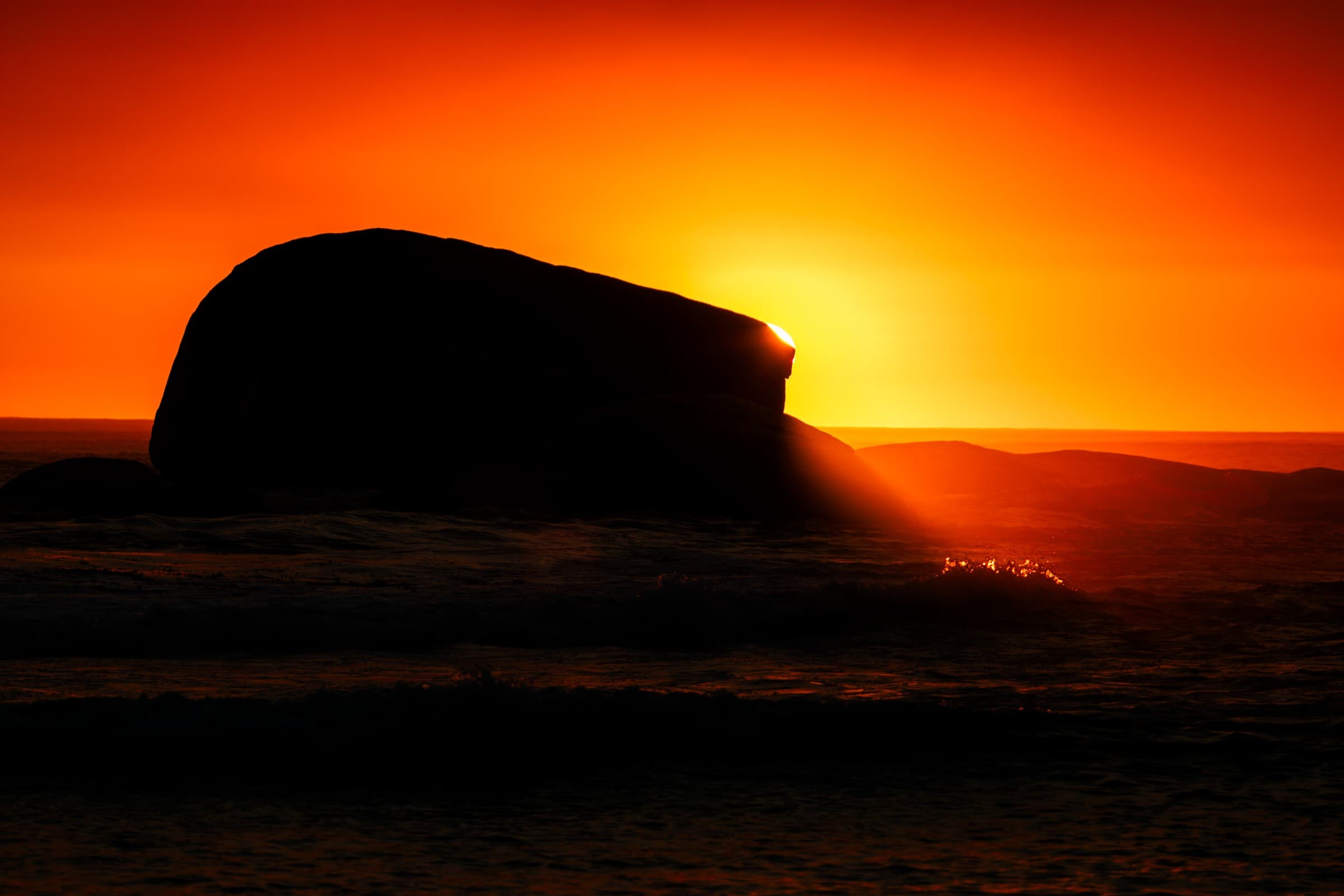
Smokey autumn days during burn-off season make for incredibly red sunsets in the South West. Isaac Rock stands silhouetted against one of them in April.
Autumn in the South West is burn-off season, and the smoke that drifts off the prescribed burns does something to the light that no filter reproduces honestly: it strips the blue out of the sky and leaves the sun sitting in a band of red that reaches all the way down to the horizon.
Against that, Isaac Rock goes completely black. There is no detail left in it — just the profile, hard against colour. It is the most reduced version of this rock in the collection, and arguably the most accurate to how it would have looked from the deck of a ship standing in too close to this coast.
This is the print offered in the largest range of sizes in the collection, up to A2 on Hahnemühle Photo Rag, because the gradient in the sky needs room to resolve.
About Isaac Rock
Isaac Rock stands off the Calgardup Bay shoreline within sight of where the SS Georgette came ashore. At the time of the wreck in 1876 it was known as Black Rock; today it carries the name Isaac.
That name is the reason this rock recurs through the exhibition. Sam Isaacs, the Aboriginal stockman who rode to the beach with Grace Bussell on the morning of the wreck, was awarded a bronze medal for his part in the rescue while Bussell received silver, a gold watch and a town named after her. The rock is one of the few things on this coast that carries his name at all. Photographing it repeatedly, in every condition the coast offers, is the exhibition's way of keeping him in the frame.
The full account of the wreck — the failed pumps, the lifeboat, Grace Bussell and Sam Isaacs, and the inquiry that followed — is set out in the story of the SS Georgette. The research behind it is described in the author's preface.
About the print
Printed to order on Hahnemühle Photo Rag, a 100% cotton archival paper, and supplied with an edition number. Free shipping within Australia.